

Josh was 44 years old, a father of three, and by every visible measure, the picture of health. Athletic, active, and capable of carrying all the luggage on a trip to Italy. He was not the image most people have of someone with a terminal lung disease. But beneath the surface, something was silently and rapidly destroying his lungs.
The diagnosis was idiopathic pulmonary fibrosis, or IPF – a progressive condition in which lung tissue becomes scarred and hardened. There is no cure. And for Josh, the disease was advancing faster than almost anyone around him could see.
The Frustration of “Looking Fine”
For months, Josh and his wife Stacy found themselves navigating a healthcare system that simply could not validate what he was experiencing. He felt worse week over week. He said so, repeatedly. But when doctors pulled up his CT scans, the changes appeared minimal. “Come back in six months,” they were told.
“I’m feeling worse. I’m telling you, I’m feeling worse.” And they would pull up the CT scans and say there’s a little bit of difference, but not a lot.
Josh
It’s a story that will feel painfully familiar to many patients with complex or invisible illness. In a healthcare system increasingly optimised for throughput and volume – what some clinicians call conveyor belt medicine – the nuanced, progressive, hard-to-see deterioration of a patient like Josh can fall through the cracks.
Stacy, who works in health and wellness for TechnoGym, described the period as one of profound confusion and frustration. “Everyone sort of pointing fingers as to who does what, where, when, and how,” she said. “And if you looked at him, he looked healthy.”
How Medimprove Was Different
Medimprove was founded on a specific conviction: that fragmented, siloed care is not good enough for patients with complex cardiopulmonary conditions. Founded in Belgium by Professor Dr. Wilfried De Backer, one of Europe’s most respected pulmonologists, Medimprove was conceived as a true one-stop approach bringing CT imaging, lung function testing, rehabilitation, and specialist expertise together under a single roof.
In Atlanta, that vision found a powerful local champion in Dr. Paul Scheinberg, a seasoned pulmonologist and former Chief Medical Officer of Emory St. Joseph’s Hospital, who had spent his career caring for patients with severe lung disease and growing increasingly frustrated by the direction healthcare was heading.
“When medicine became industrialised, corporatised, doctors are no longer their own boss. They have mandates to produce volume. They have mandates that limit their time with each patient. And patients are feeling the squeeze.”
Dr. Paul Scheinberg, Medimprove
Josh came to Medimprove through a remarkable coincidence: his wife Stacy, through her role at TechnoGym, was already working with the clinic as it was being built. She mentioned Josh’s situation to Dr. De Backer and Dr. Scheinberg. They brought him in. Josh became patient number one at the Atlanta facility.
The Technology That Changed Everything: Functional Respiratory Imaging
What Medimprove could see that other clinics could not came down to one transformative technology: Functional Respiratory Imaging (FRI), developed by Fluidda, and central to Medimprove’s advanced diagnostic approach.
Where a standard CT scan shows a flat, two-dimensional image, FRI uses artificial intelligence to reconstruct the lungs as precise 3D models capturing not just what they look like, but how they actually function. It can quantify the extent of fibrosis with a precision that conventional imaging simply cannot match.
When applied to Josh’s scans, the difference was stark:
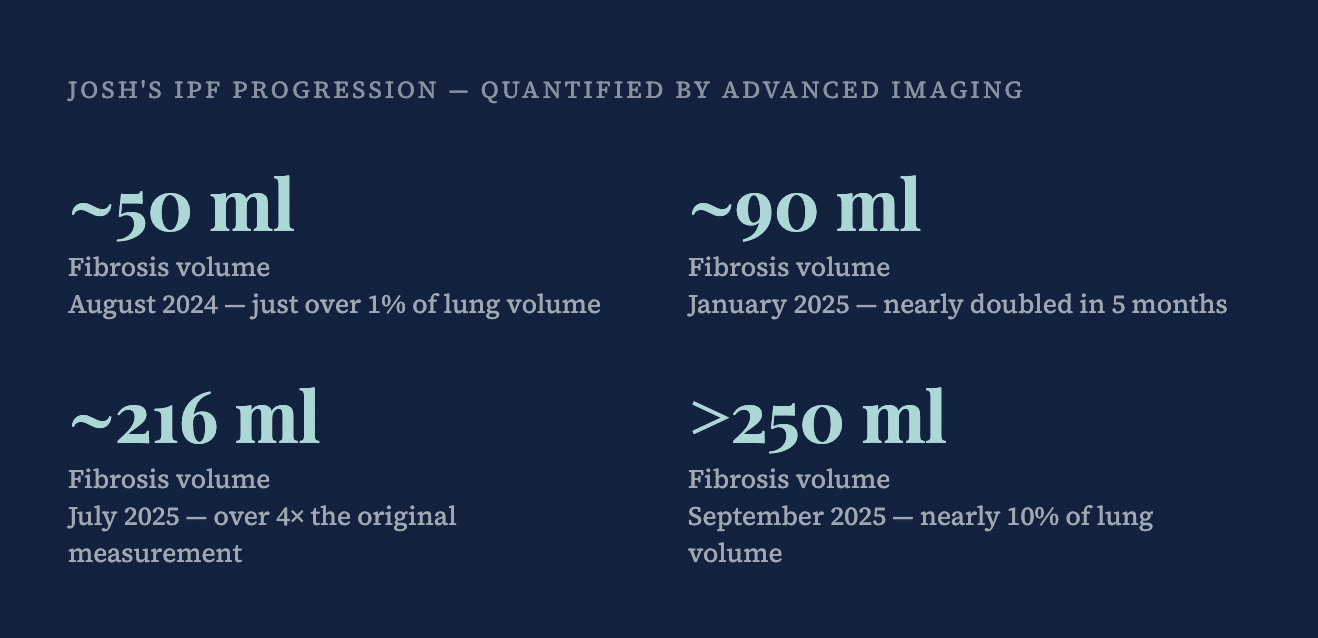
In that same period, Josh lost 1.3 litres of total lung volume – roughly the size of a large party balloon. Standard CT scans showed only modest visible change. FRI revealed a lung that was rapidly running out of time.
“Any other patient without access to this technology would get worse and worse and worse until finally everybody realises he needs a transplant. But at that point it may have been too late.”
Dr. Jeremy Amayo, Medimprove
Pulmonary Rehabilitation and the Full-Person Approach
Alongside the imaging work, Josh was enrolled in Medimprove’s pulmonary rehabilitation programme, overseen by respiratory therapist Sebrena Mallard. Despite being in excellent physical shape, Sebrena quickly noticed what the gym equipment was revealing: Josh’s oxygen saturation would drop into the low 80s during cycling – a warning sign invisible to the eye, but critical in clinical terms.
Over time, supplemental oxygen became necessary across more and more of his workout. It was a gradual, measurable indicator of declining function – and it was being carefully tracked.
“Sometimes he would look at me, so short of breath, and between breaths he’d say: ‘This sucks.'”
Sebrena Mallard, Medimprove
The Team Behind Josh’s Care
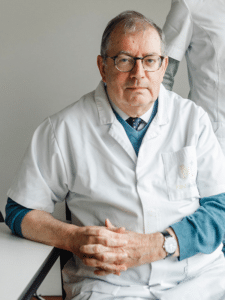
Professor Dr. Wilfried De Backer – Co-Founder, Medimprove – Pulmonologist
One of Europe’s most respected respiratory specialists, with decades of experience treating complex lung disease. Founder of the integrated cardiopulmonary care model that Medimprove is built on.
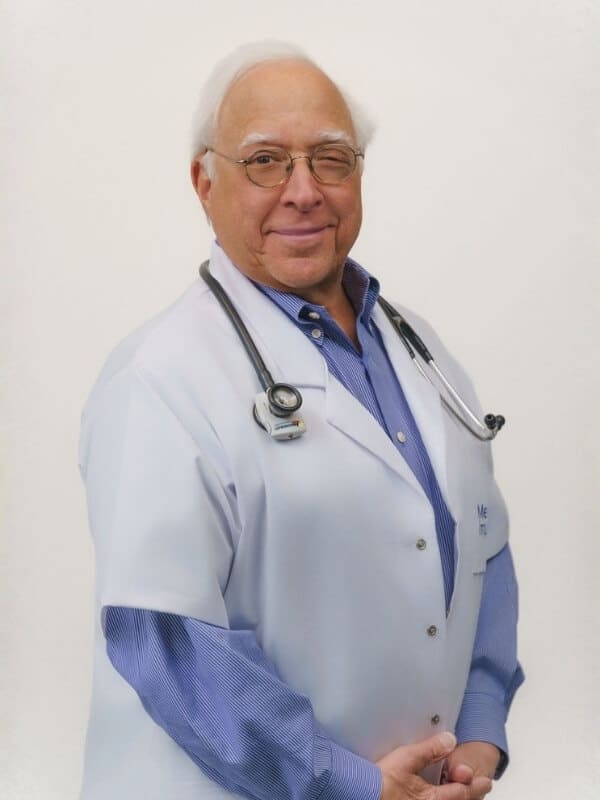
Dr. Paul Scheinberg – Pulmonologist – Former CMO, Emory St. Joseph’s Hospital
A seasoned pulmonologist who has spent his career advocating for patients with severe lung disease. His connections and advocacy were instrumental in securing Josh’s place on the transplant list.

Dr. Jeremy Amayo – Lead, Cardiopulmonary Performance & Innovation
A physician assistant with a PhD in medical education and deep expertise in treating the whole person. Dr. Amayo led the use of FRI technology to quantify Josh’s disease progression and build the clinical case for transplant.

Sebrena Mallard – Respiratory Therapist
An experienced respiratory therapist focused on patient education, rehabilitation, and whole-person care. She monitored Josh’s exercise tolerance closely, observing the measurable decline that helped confirm the urgency of his case.
Where Josh Is Today
Thanks to the data Medimprove gathered – and thanks to Dr. Sheinberg advocating on Josh’s behalf – Josh is now on the double lung transplant list.
Without the FRI technology, without the pulmonary rehabilitation monitoring, without the team who refused to accept a “come back in six months” answer, the story might have had a very different ending. The imaging data showed what the naked eye and standard scans could not. And it gave Josh’s team the evidence they needed to fight for him.
“I wasn’t just another number. They really cared about me. Everyone from the CT tech to the pulmonology specialist – they were an advocate for me.”
Josh, Medimprove Patient #1, Atlanta
His goal now? To walk his daughter down the aisle.
What IPF Patients and Their Families Should Know
Idiopathic pulmonary fibrosis is a serious, progressive lung disease that affects thousands of Americans each year. It causes scarring of lung tissue that gradually reduces the ability to breathe, and there is no cure. Key facts:
– IPF can progress silently, especially in otherwise healthy individuals.
– Standard CT imaging may not capture early or rapidly changing fibrosis accurately.
– Early, accurate diagnosis is critical – and may dramatically affect outcomes.
– Integrated care – combining specialist expertise, advanced imaging, and rehabilitation – leads to better-informed decisions and better patient outcomes.
If you or someone you care about has been told their lungs “look okay” but symptoms are worsening, it may be time to seek a second opinion – and to ask about advanced imaging technology like Functional Respiratory Imaging.